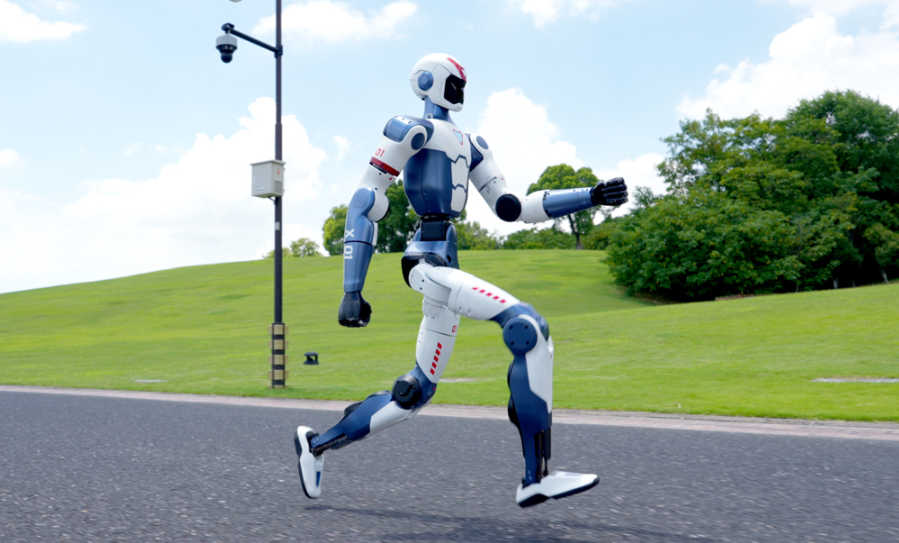
China is pioneering a novel approach to bolster its embodied artificial intelligence (AI) sector by employing human “cyber workers” to train humanoid robots. Local authorities have launched numerous “robot training centers” aimed at generating essential movement data necessary for the advancement of autonomous humanoid robots.
In a revealing report by Rest of World, the inner workings of these facilities come to light, including ones operated by a Shanghai robotics startup. These centers utilize hundreds of young workers, referred to as “cyber-laborers,” who don virtual reality headsets and exoskeletons, performing repetitive tasks such as folding clothes and manipulating microwaves. The aim is to meticulously capture these movements for data sets that can enhance the functionality of humanoid robots in tasks ranging from household chores to manual labor.
A 20-year-old computer science student and part-time cyber-laborer stated, “We call ourselves cyber-laborers. It’s a fine gig, though it’s a bit boring.”
Recognizing the significance of “embodied intelligence,” or AI that exists in physical form, China has prioritized this field, leading to an influx of investment and the emergence of various robotics startups. These companies are banking on data collection to mirror the success seen in AI chatbot development. However, numerous challenges remain, as training robots requires complex datasets that cannot easily be sourced online.
State-funded training centers have become the backbone of this initiative, with over 40 launched nationwide in the past year, around two dozen of which are fully operational. These expansive facilities, like one in Beijing covering more than 10,000 square meters, employ hundreds to instruct robots on executing specific tasks, such as operating machinery in assembly lines or assisting in elder care. In Hubei, another center employs around 100 workers to teach robots household tasks like ironing and cleaning.
Notably, these training centers receive significant government backing, contrasting sharply with the venture-capital-driven approach in the U.S. Local governments not only fund the centers but also create special funds for embodied AI, offering subsidies and resources to startups, reminiscent of support previously seen in China’s electric vehicle sector.
Though some U.S. companies like Tesla have utilized human data generation for robotic training, these efforts are far less extensive. Ken Goldberg, a robotics researcher at the University of California, finds China’s strategy compelling but raises concerns about the time investment required for manual data collection. He mentioned that the country is also exploring digital simulations to enhance data generation efficiency.
The global enthusiasm for embodied AI is surging, with projections from Goldman Sachs suggesting that the market for humanoid robots could exceed $38 billion by 2025. Currently, China boasts over 150 startups dedicated to developing humanoid robotics, including notable firms like AgiBo Innovation Technology Co. Ltd., Unitree Robotics Co. Ltd., and Galaxy General Robot Co., or Galbot.