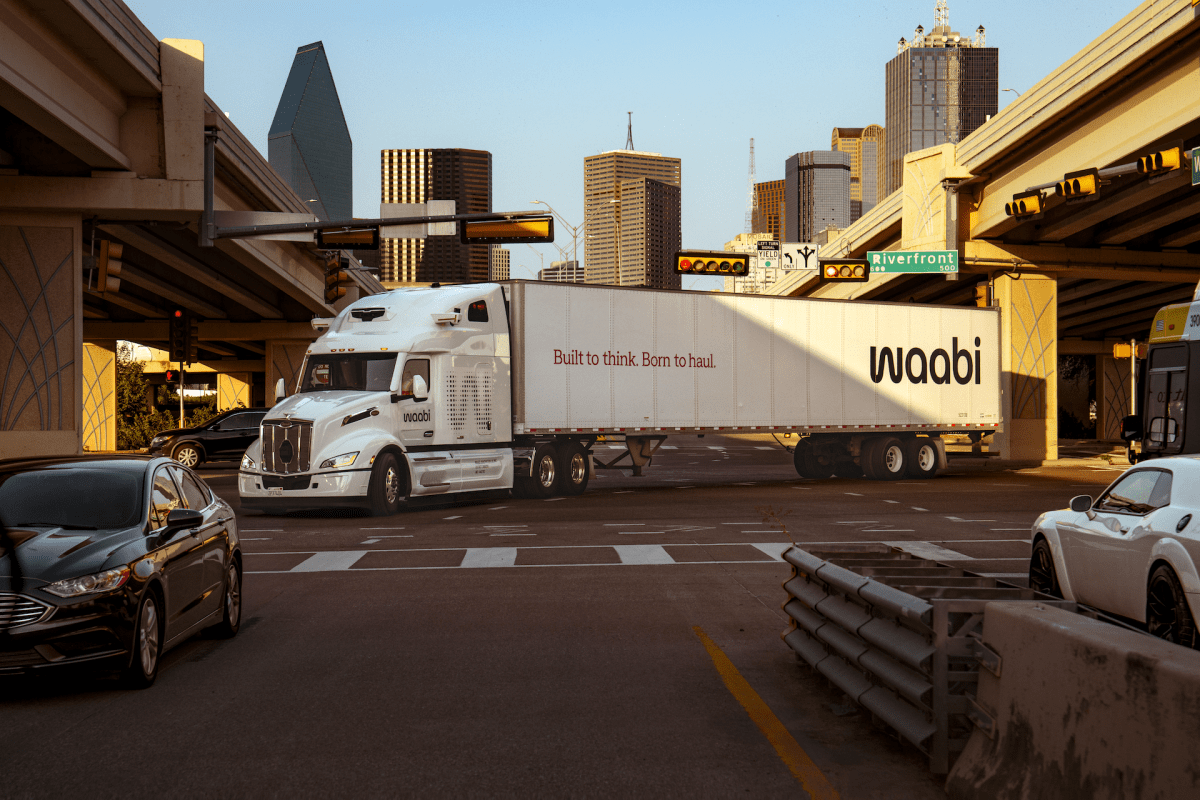
Autonomous vehicle company Waabi has successfully secured $1 billion in funding and entered into a strategic alliance with Uber to launch self-driving vehicles on the ride-hailing platform. This marks Waabi’s first venture beyond its established focus on autonomous trucking, an expansion designed to leverage Waabi’s innovative technology in the robotaxi market.
The funding consists of a $750 million Series C round that was oversubscribed and co-led by Khosla Ventures and G2 Venture Partners, alongside $250 million from Uber, aimed at rolling out over 25,000 Waabi Driver-powered robotaxis exclusively through Uber’s services. While the companies have not specified a timeline for this ambitious deployment, the partnership underscores the emerging potential of Waabi’s AI technology to navigate the challenges of scaling across different self-driving sectors.
Unlike competitors like Waymo, which has struggled with its dual focus on robotaxis and trucking, Waabi’s founder and CEO Raquel Urtasun claims that the company’s approach capitalizes on a generalizable AI architecture that can service both markets efficiently. Urtasun, a former chief scientist in Uber’s autonomous vehicle division, reiterates her confidence in Waabi’s cost-effective strategy.
This collaboration builds on Waabi’s prior relationship with Uber Freight, as the company continues to explore other partnerships for deploying autonomous vehicles on a global scale. The company has joined forces with several other firms like Nuro, Wayve, and Momenta in Uber’s ecosystem.
In parallel with this funding, Uber has launched a new initiative, Uber AV Labs, to collect data for its AV partners. Waabi utilizes a sophisticated simulator known as Waabi World for training and validation, enabling its technology to adapt and learn through real-time sensor simulation without human input. This unique methodology positions Waabi to achieve a level of adaptability akin to human reasoning, allowing for more efficient learning from fewer examples compared to traditional systems.
Having spent over four years refining its technology for both highways and surface streets, Waabi aims to disrupt the industry further. Urtasun has indicated that Waabi’s capabilities extend beyond vehicles to potentially include robotics in the future, supporting the long-term vision that has always included robotaxis.
Waabi is on a trajectory to build faster and more economically than its competitors, claiming that its approach considerably reduces the need for extensive human resources and data centers. This recent round of funding elevates Waabi’s total capital raised to approximately $1.28 billion, following a $200 million Series B in mid-2024.
As the company gears up to launch commercial pilots, which have initially involved human drivers in Texas, projections for a fully driverless truck have faced delays. However, Urtasun remains optimistic about demand due to Waabi’s direct-to-consumer model, anticipating rapid market penetration through the partnership with Uber.
While details about the vehicle manufacturers involved in the Uber roll-out are still under wraps, Urtasun indicates that Waabi plans to employ a vertically integrated approach by developing sensors and technology directly at the manufacturing level to ensure safety and scalability in its autonomous offerings.
Key Points:
– Waabi raises $1 billion in funding, partners with Uber.
– Plans to deploy 25,000 robotaxis on Uber’s platform without a set timeline.
– Emphasizes a generalizable AI architecture to scale across markets.
– Utilizes advanced simulations for training and validation of autonomous driving systems.
– Previous experience from Urtasun as Uber’s chief scientist adds industry expertise.
– Waabi’s total funding now approximates $1.28 billion, with future plans targeting robotics.