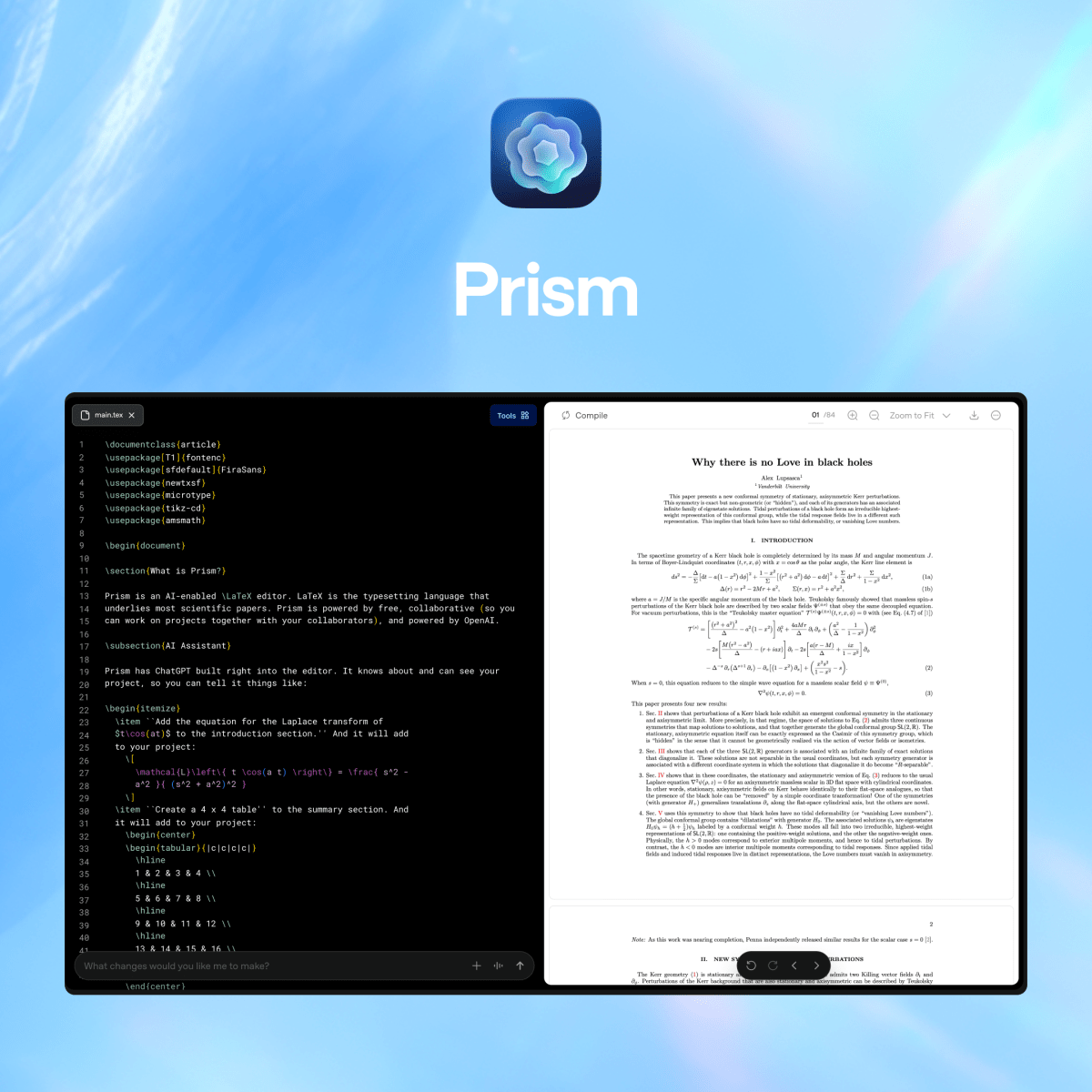
OpenAI has introduced Prism, a groundbreaking AI workspace tailored for scientific research, now accessible for free to all ChatGPT users. This innovative tool serves as an AI-enhanced word processor and research assistant, utilizing the advanced capabilities of GPT-5.2 to help scientists evaluate claims, refine text, and conduct literature searches.
Prism is not intended to autonomously carry out research; instead, it is designed to amplify the work of human researchers. OpenAI’s leaders liken Prism to programming interfaces like Cursor and Windsurf, positing it will significantly expedite scientific endeavors. Kevin Weill, OpenAI’s VP of Science, stated during a press briefing, “I think 2026 will be to AI and science what 2025 was to AI and software engineering.”
The launch comes amid a notable uptick in scientific inquiries directed at OpenAI’s consumer products. ChatGPT reportedly handles around 8.4 million messages weekly regarding advanced scientific topics, though the proportion originating from professional researchers remains uncertain.
AI-assisted research is increasingly prevalent in academia. For instance, AI models have recently aided mathematicians in successfully demonstrating various longstanding Erdős problems by blending literature analysis with innovative applications of established techniques. While the implications of these proofs continue to spark debate, they represent early successes for advocates of AI and formal verification systems.
In December, a statistics paper utilized GPT-5.2 Pro to derive new proofs related to foundational statistical axioms, with human researchers primarily overseeing and validating the model’s contributions. OpenAI highlighted this achievement in a blog post, framing it as a model for enhanced human-AI collaboration in future research.
The innovative features of Prism largely stem from improving existing productivity standards. The program integrates seamlessly with LaTeX, the prevalent open-source typesetting system for scientific literature, while also enhancing the user experience significantly beyond conventional LaTeX tools. Additionally, it employs GPT-5.2’s visual capabilities, enabling researchers to create diagrams from online whiteboard content—a common challenge with existing software.
One of Prism’s standout features is its ability to merge AI’s capabilities with rigorous context management. Users can access a ChatGPT window within Prism, allowing the model to consider the entire research project’s context, which leads to more relevant and insightful responses.
While savvy users of GPT-5.2 could achieve similar outcomes, OpenAI aims to attract scientific researchers with a more streamlined interface. Weill noted, “Software engineering accelerated in part because of amazing models, and in part because of deep workflow integration.”
Prism embodies these principles, marking a significant advancement in the landscape of AI-assisted scientific research.