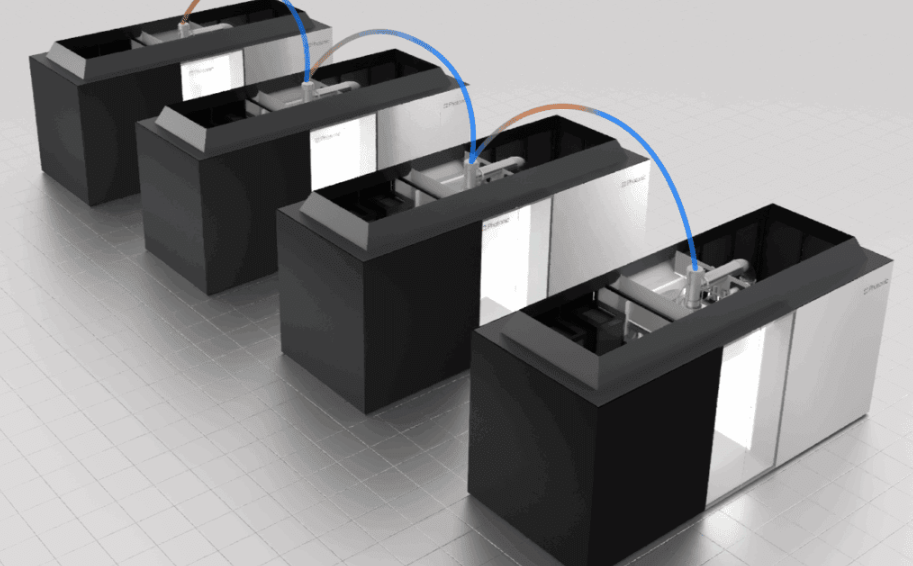
Canadian quantum computing startup Photonic Inc. has successfully secured CAD $180 million (approximately $130 million) in funding, marking a significant step in the initial phase of its latest investment round. The company aims to significantly increase this amount in the coming months as it enhances its networking technology based on quantum entanglement, which is pivotal for the advancement of quantum computers. This round was led by Planet First Partners, based in London, and also included investments from Telus Corp.’s venture capital branch, along with contributions from existing investors Microsoft Corp. and BCI, raising Photonic’s total funding to $271 million.
Photonic is on a mission to create the world’s first highly scalable fault-tolerant quantum computer. Utilizing quantum entanglement, the company can network potentially thousands of qubits, enabling them to collaborate effectively for complex calculations. Quantum entanglement denotes the unique phenomenon in quantum physics where two particles can remain interconnected regardless of distance, offering the promise of teleporting information between qubits.
In an interview with BetaKit, Stephanie Simmons, co-founder and Chief Quantum Officer of Photonic, discussed the company’s strategy to leverage entanglement to tackle the scalability challenges faced by quantum computers. She noted that while these advanced machines hold the promise of solving challenges beyond the capabilities of classical computers—spanning fields from drug discovery to machine learning—they require a fundamentally different approach to computation using qubits, which can exist in multiple states at once (0, 1, or both).
However, the inherent instability of qubits presents significant hurdles; any disturbances, such as vibrations or temperature changes, can lead to computational errors. Hence, maintaining qubits requires careful conditions, often necessitating extreme low temperatures or vacuum environments. Achieving this on a large scale is critical, motivating Photonic’s focus on using entanglement to manage thousands of qubits without needing to contain them all physically together.
The company’s ambition is to operate its quantum computing systems as a service for governments and corporations, akin to current cloud computing models. A significant partnership with Microsoft, which aims to integrate Photonic’s technology within its Azure cloud platform, exemplifies this approach.
Nathan Medlock of Planet First Partners expressed confidence in Photonic’s potential, highlighting quantum computing’s ability to drive breakthroughs in sectors such as clean energy, advanced materials, and healthcare. He believes Photonic’s architecture offers a viable route to scaling towards utility-scale systems, which are essential for innovations that can address climate change and enhance global health.
Photonic’s CEO, Paul Terry, indicated that this funding round is merely the beginning, as the company is proactively seeking to raise up to $250 million within the next three months, engaging with potential investors to support this ambitious expansion.
Canada continues to assert itself as a leader in quantum computing technology, home to notable firms like D-Wave Quantum Inc.—which claims to be the world’s only provider of a fully operational quantum computer—and Xanadu Quantum Technologies, which recently announced plans to go public in partnership with a Nasdaq-listed SPAC.
Key Highlights:
– Photonic Inc. secures CAD $180 million ($130 million) in funding to advance quantum entanglement technology.
– Led by Planet First Partners, with participation from Microsoft and Telus Corp.
– Aims to develop scalable, fault-tolerant quantum computers.
– Plans to operate quantum systems as a service for various sectors.
– Canada emerges as a leader in the quantum technology space.