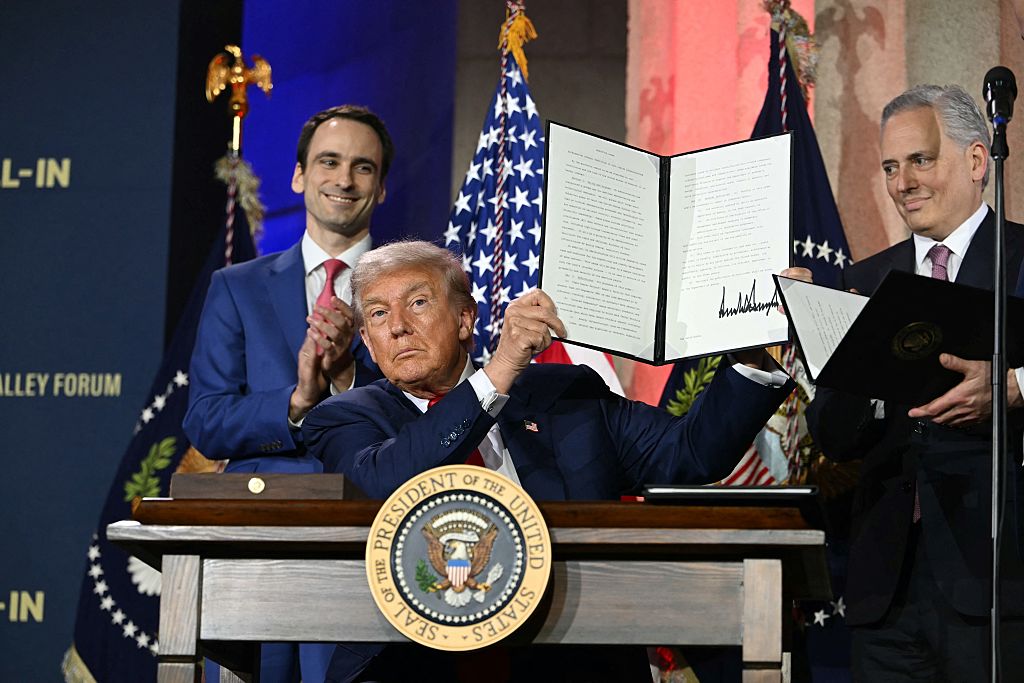
President Donald Trump has enacted an executive order aimed at addressing the challenges posed by varying state laws on artificial intelligence (AI) for startups. Signed on Thursday evening, the order encourages federal agencies to contest state regulations, arguing that a consistent national policy is essential for promoting innovation in the AI sector.
The directive, titled “Ensuring a National Policy Framework for Artificial Intelligence,” mandates the Department of Justice to form a task force within 30 days to review and potentially challenge state laws that could hinder interstate commerce relating to AI. Additionally, the Commerce Department has been given 90 days to identify state regulations deemed excessive, a move that may influence states’ qualifications for federal funding, including broadband grants.
Furthermore, the order instructs the Federal Trade Commission (FTC) and the Federal Communications Commission (FCC) to explore the establishment of federal standards that could override state laws, while also calling on the administration to collaborate with Congress on creating a unified AI legal framework.
This executive action coincides with a wider movement to establish a cohesive national strategy for AI regulation amidst stalled legislative efforts in Congress to impose a pause on state regulations. Advocates from both political parties contend that a lack of federal guidance could lead to inconsistent protections for consumers and unregulated business practices.
Michael Kleinman, Head of U.S. Policy at the Future of Life Institute, criticized the order as a measure benefiting Silicon Valley elites, implying that it allows tech giants to escape accountability. Meanwhile, Trump’s AI and crypto advisor, David Sacks, has been a vocal proponent of this regulatory shift.
Even proponents of a national approach acknowledge that the order does not create a definitive framework. The continued enforcement of state laws poses a significant challenge for startups, which may encounter prolonged uncertainty as they navigate the legal landscape while awaiting congressional action.
While some argue that centralizing AI regulation in Washington could alleviate confusion, detractors warn that ensuing legal disputes might impede startups, complicating their efforts to meet both state and federal expectations.
Concerns are echoed by Arul Nigam, co-founder of Circuit Breaker Labs, who highlighted the negative impact of legal ambiguity on selling AI solutions to cautious sectors such as finance, legal, and healthcare. This uncertainty can lengthen sales cycles and inflate operational costs, with the perception of unregulated AI further eroding trust, which is crucial for broader adoption.
Moreover, Gary Kibel, a partner at Davis + Gilbert, expressed caution, noting that an executive order may not be the most appropriate method to override state-enacted laws, raising concerns that the current environment could lead to either overly restrictive regulations or complete inaction—scenarios that might favor larger tech companies.
Morgan Reed, president of The App Association, urged Congress to promptly establish a focused national AI framework to avoid the complications of inconsistent state laws and prevent a prolonged legal struggle over the executive order’s constitutionality.
Key Points:
– Trump’s executive order aims to unify AI regulation across states.
– The Department of Justice will challenge state laws within 30 days.
– A 90-day timeline for the Commerce Department to identify excessive regulations is established.
– Critics warn of ongoing uncertainty for startups amid efforts for a national framework.